Own the AI layer
Deploy, grade and govern your client's AI agents yourself, whoever built them.
Solutions / BPOs and outsourcers
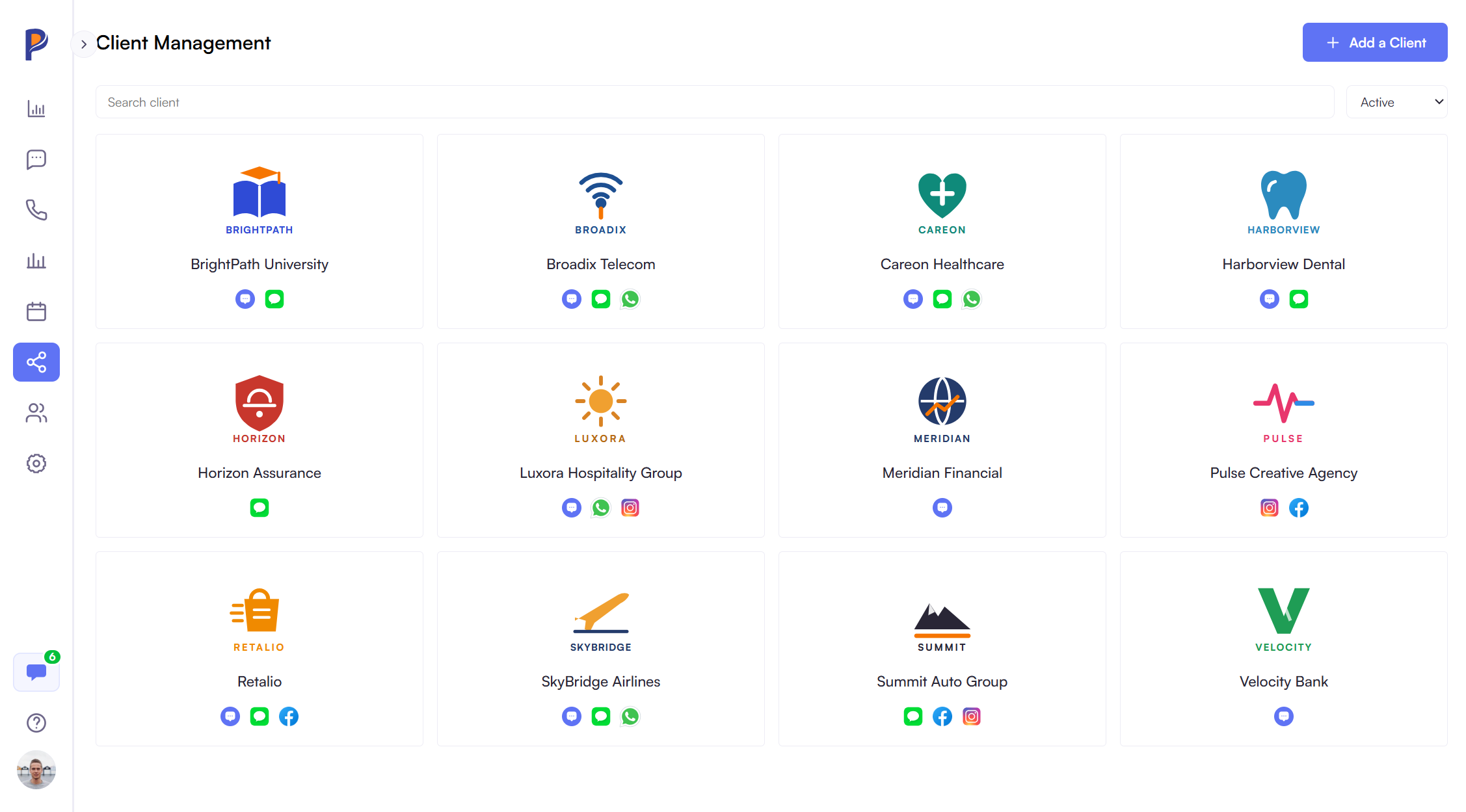
Palera is multi-client from the ground up. Each client gets its own campaigns, numbers, AI agents, dashboards and data, and your agents work all of them from one screen. That is how TheConnection earns more revenue per agent hour than on any platform it used before.
Built for your shape
In Palera, each client is a first-class object with its own campaigns, numbers, knowledge base, dispositions, forms, dashboards and access. Palera was built by people who ran an outsourcer. Most contact center platforms were designed for one enterprise running its own floor, and multi-tenancy was added later.
The structural problem
A BPO cannot stop a client's AI program from removing seats, and should not try. What a BPO can do is own the layer the AI runs on, so the volume that leaves its seats arrives on its own platform instead of somebody else's.
Deploy, grade and govern your client's AI agents yourself, whoever built them.
Your client owns their conversation history. You keep it organized, labeled and ready for their AI, which makes you hard to replace.
The numbers the client reviews come out of your platform, in your meeting.
Your platform charges you per seat, per minute of usage or both, because that is good for the platform. Your clients pay you for results. Palera charges the way you bill: per conversation, or per outcome for high-volume programs.
When a client wants to point their own AI at the work you do for them, you can give them governed, scoped, audited access through the Palera MCP server instead of exporting a copy of the relationship.
There is no other CCaaS that can automate and manage as many clients and channels in one single agent interface. That has created efficiency which earns us more revenue per agent hour than any other platform we have ever used.Fred Weiner, CEO, TheConnection
The objection we hear first
You do not have to change platforms. Palera runs as a layer on top of the CCaaS your client insists on, taking the AI agents, the grading, the governance and the reporting, and leaving their telephony contract exactly where it is. Or run the whole floor on Palera as your full CCaaS, and the record and the AI layer work the same way.
The layer deployment turns a platform replacement decision into an operations decision, which is a conversation you can actually have this quarter.
Economics
A $150 CCaaS seat used one shift a day costs about 85¢ for every hour an agent works, roughly 15¢ per support conversation before a single AI add-on. Palera is 4.9¢, falling to 3.2¢ at volume, and an idle seat costs you nothing at all.
Source: Palera analysis of per-seat CCaaS pricing.
We will run it on your volume, on their CCaaS or ours, and you can see the economics before you move anything else.
Audited, compliant and recognized. Every client's data is segmented and runs in its own separate instance.