






Every CCaaS vendor will tell you they can handle customer experience.
Technically, that’s true.
But only if you’re okay with:
- extra layers
- extra integrations
- extra charges
- extra fragility
Because out of the box, CCaaS is still channel-first.
Channel-First Is the Hidden Constraint
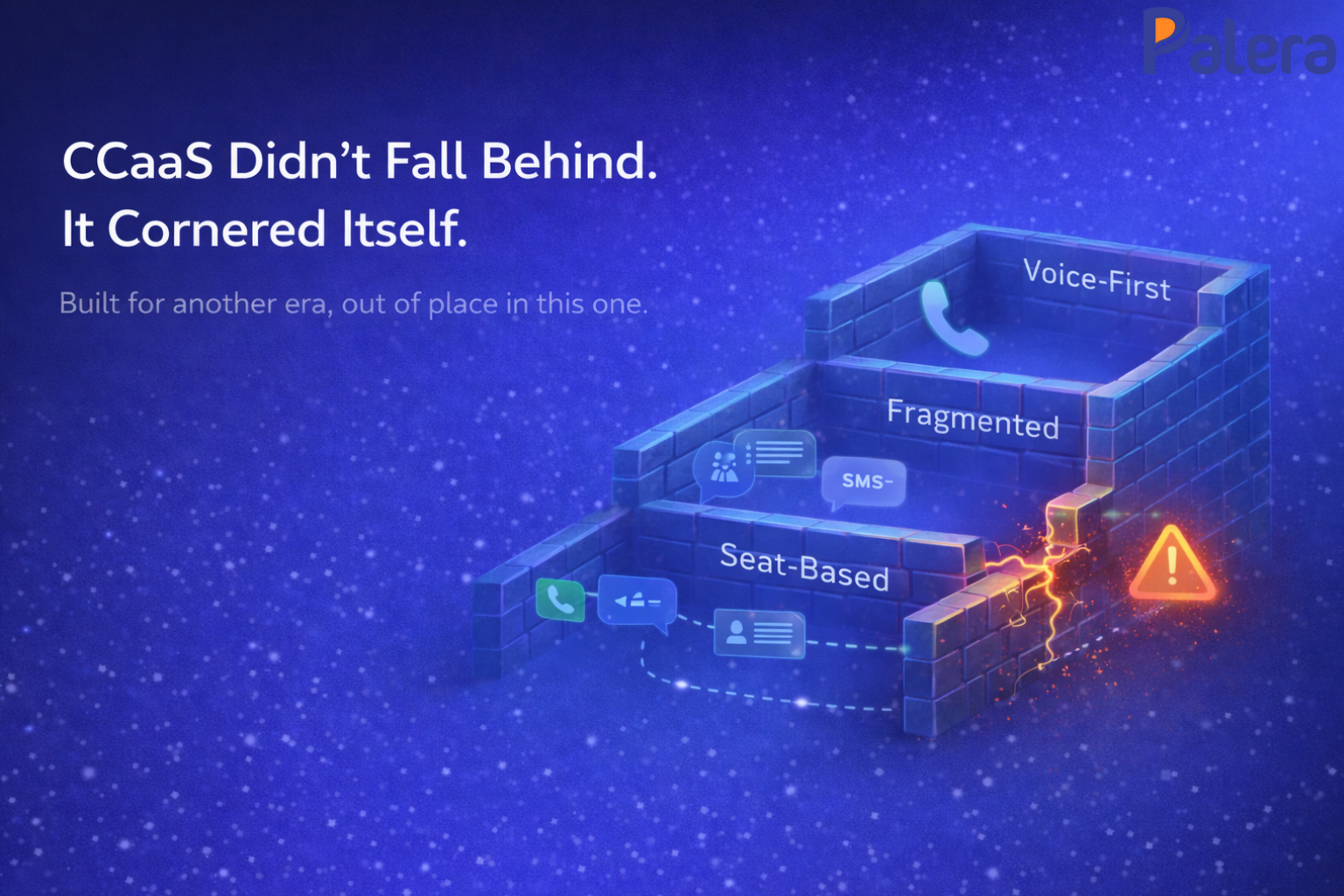
Most CCaaS platforms were built to manage channels, not conversations.
So the data ends up split:
- voice data here
- chat data there
- messages somewhere else
Each channel optimized independently.
Each interaction treated as a separate event.
Real-time conversation memory across channels?
Not native.
Not simple.
Not included.
The Cost of “Making CX Work”
To approximate a cohesive experience, teams start stacking workarounds:
- custom integrations
- middleware
- data sync jobs
- reporting layers
- manual processes
You’re no longer buying a CX platform.
You’re assembling one.
And you pay for it twice:
- once in software costs
- again in operational complexity
At first, it feels manageable.
The demos look fine.
The roadmap sounds promising.
Until It Doesn’t
Over time, the cracks show.
Context breaks between channels.
Escalations feel inconsistent.
Customers repeat themselves.
Fixes take longer.
Changes ripple unexpectedly.
Every adjustment adds more fragility.
And by the time the pain is obvious, you’re locked in.
That’s the regret no one admits on the call:
CCaaS can do CX -
but only awkwardly, expensively, and late.
Customers Feel the Friction Even If You Don’t See It
From the inside, these issues look technical.
From the outside, they feel personal.
Customers don’t care about:
- integrations
- system boundaries
- channel ownership
They care that the system doesn’t remember them.
Every workaround leaks friction into the experience.
And customers feel every bit of it.
The Real Signal
If delivering good CX requires constant workarounds,
the platform wasn’t built for CX.
It was built for fulfillment.
And no amount of layering turns a fulfillment system
into a conversation system.
Final Thought
Customer experience doesn’t fail because teams don’t try hard enough.
It fails when the underlying infrastructure was never designed to support it.
If CX has to be assembled, maintained, and defended at every step,
it’s not a feature gap.
It’s a foundation problem.