

.png)




Every AI agent company hits this wall eventually.
Most just don’t admit it publicly.
If you’re building AI agents for customer experience, there’s a nightmare you’re probably already living in.
It’s not the model.
It’s not hallucinations.
It’s not prompt tuning.
It’s your customer’s CCaaS.
Day One: Naive Optimism
On day one, it feels manageable.
“Yeah, they already have a CCaaS. We’ll just integrate.”
Then reality kicks in.
You realize you have to build middle layers just to survive:
- pull data out of their CCaaS
- normalize it
- map it
- sync it back
- keep it from breaking every time they change something
And all of this…
just to get partial conversation data.
The Real Conversation History Is Siloed
Because the conversation history you actually need?
It’s siloed.
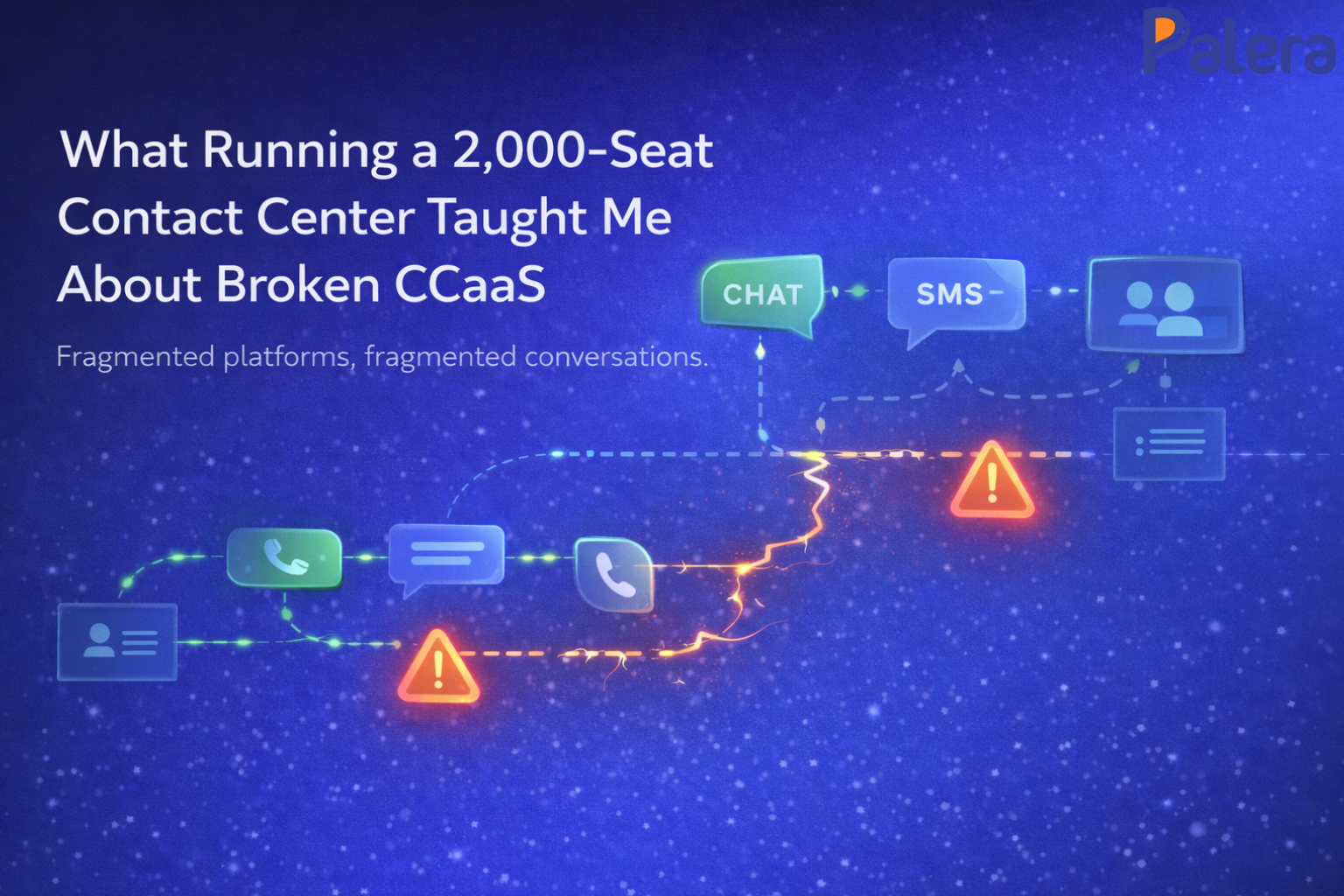
Voice in one place.
Chat in another.
SMS and social somewhere else.
So your AI never sees the full customer journey.
It sees fragments.
Slices.
Moments.
Not context.
Not continuity.
Not truth.
That’s a data infrastructure problem, not an AI problem.
Then Reality Gets Worse: Humans Live in Different Systems
Meanwhile, humans are working in a completely different system.
So conversation data for agents doesn’t line up with conversation data for AI.
And that creates a deceptively bad problem no one warns you about:
You can’t benchmark AI vs humans.
Different tools.
Different data.
Different timelines.
So when a client asks:
“Is the AI actually performing better than our agents?”
You give a vague answer and hope they don’t push.
The Best Data You Have Can’t Be Used When You Need It
And the worst part?
The best training data you have -
human conversations that actually resolved issues -
can’t be fed back into the model in real time.
So learning is delayed.
Iteration slows.
Your AI gets stuck repeating the same mistakes.
Not because it can’t learn -
but because the infrastructure prevents it from seeing anything consistently.
This Is Where Most AI Agent Companies Realize the Truth
They didn’t sign up to build AI…
They signed up to build infrastructure glue.
They ended up maintaining:
- extraction layers
- normalization logic
- sync jobs
- data bridges
- channel adapters
- bureaucratic workarounds
Instead of iterating the product they imagined.
Instead of building intelligence.
Instead of scaling.
They became integration engineers for someone else’s stack.
The Root Cause: Legacy CCaaS Wasn’t Built for AI-First Execution
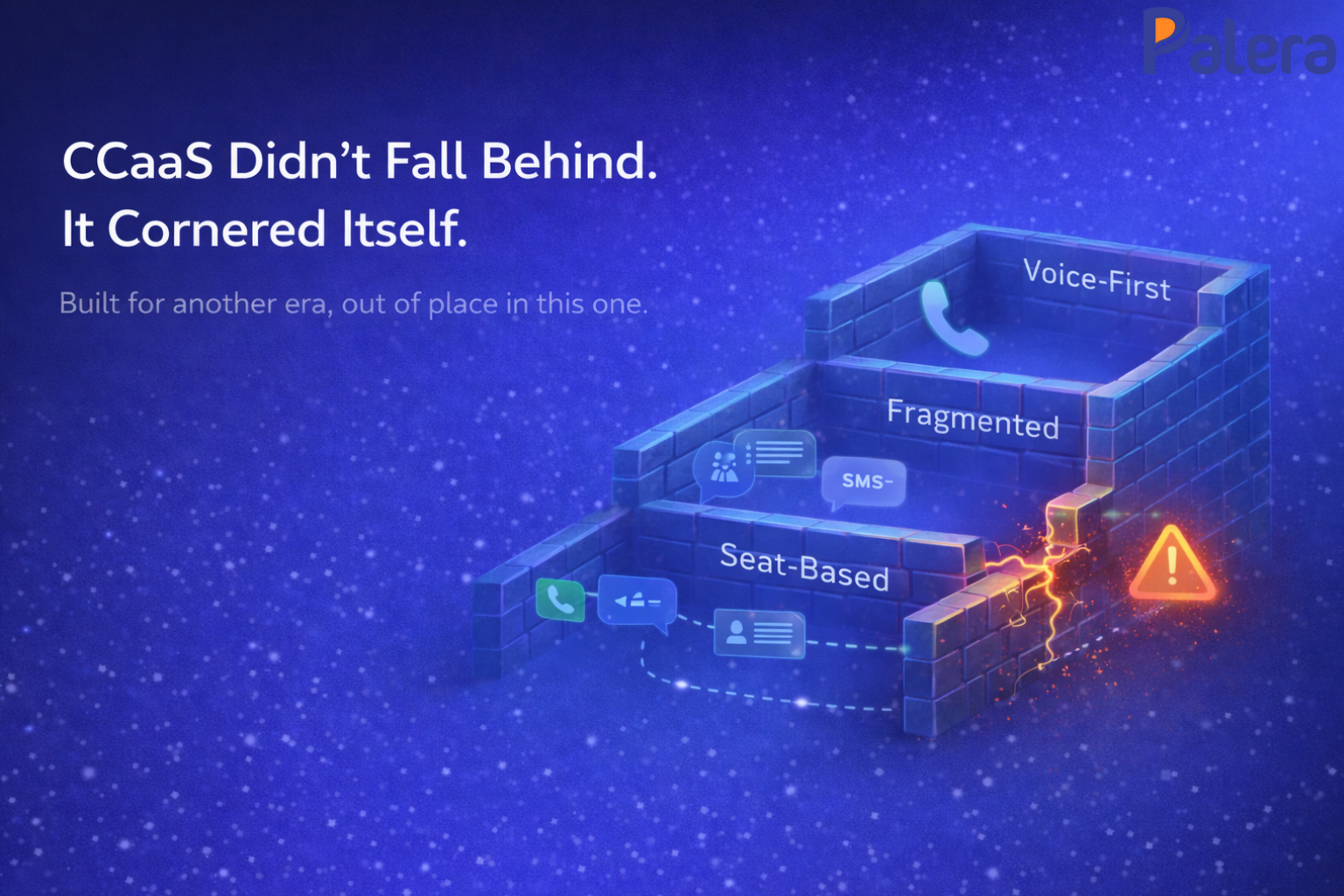
Traditional CCaaS platforms are optimized for:
- seats
- tickets
- closures
They were never designed for AI + human collaboration.
They were never built for:
- shared memory
- continuous conversation history
- unified context across channels
So when AI agents escalate to humans,
or humans augment AI,
the context resets.
Every time.
And that kills performance.
The Palera Alternative
Because if your AI can’t see what humans see -
and vice versa -
you’re not building an AI company.
You’re babysitting someone else’s broken stack.
Palera gives you:
- a shared conversation layer
- no seat licenses
- no separate contracts for numbers or channels
- purely usage-based pricing
- real-time shared context across channels
- AI and humans operating from the same history
Across SMS. Chat. Voice. Social. Everything.
- No middle layers.
- No guessing.
- No “we’ll fix it later.”
What Real AI Scale Looks Like
Real AI scale doesn’t struggle with:
- incomplete data
- disconnected systems
- fragmented history
- invisible intent
Real AI scale emerges when:
AI and humans work from a single, unified conversation layer.
That’s where learning loops actually close.
That’s where iteration accelerates.
That’s where AI earns its ROI.
Final Thought
If your AI agents keep getting stuck, resetting, or failing to prove their value - it’s not because they lack intelligence.
It’s because the infrastructure you wrapped them around was never built for intelligence at all.
AI doesn’t fail because it’s dumb.
It fails because CCaaS was never designed for AI-first execution.