

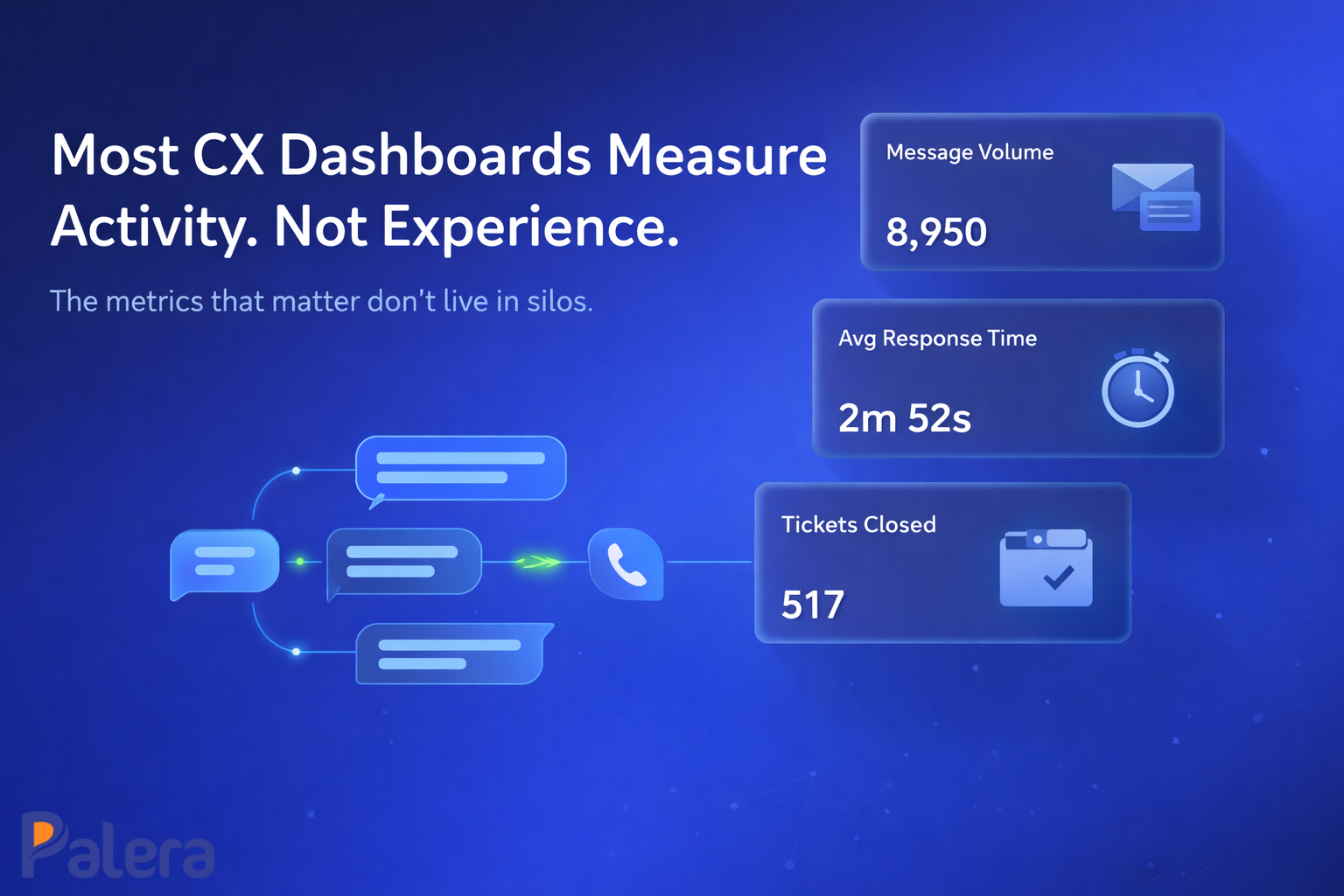




Most customer experience dashboards are full of numbers - but very few of them explain what customers actually experience.
High message volume doesn’t mean good service.
Fast replies don’t mean problems were solved.
And closed tickets don’t always mean satisfied customers.
If your CX metrics aren’t measuring trust, resolution quality, and continuity, your data may be telling a comforting story - not an accurate one.
Here are five metrics that actually reflect customer experience, and why they matter more than the numbers most teams obsess over.
Metric #1: Speed to Resolution
First response time gets a lot of attention. Resolution time gets ignored.
What matters isn’t how fast someone replies - it’s how quickly the issue is actually solved, end to end. That includes:
- Hand-offs between agents
- Channel changes (SMS → chat → voice)
- Escalations and follow-ups
A fast first reply followed by days of back-and-forth is not good CX.
Speed to resolution measures the entire lifecycle of a customer issue, not just the opening move. It’s the difference between appearing responsive and being effective.
Metric #2: Context Retention
Did the customer have to repeat themselves?
Every time a customer restates their issue, trust erodes. Repetition signals fragmentation - between systems, channels, or people.
Context retention measures whether conversation history actually travels with the customer. When it breaks, friction spikes. When it’s preserved, interactions feel informed and human.
This is one of the strongest indicators of CX quality - and one of the least measured.
Metric #3: First-Contact Resolution Quality
Resolution isn’t binary.
A ticket can be marked “closed” and still feel unresolved to the customer. True first-contact resolution means the issue was handled cleanly - without restarts, transfers, or confusion.
When agents (and AI) operate without shared context, outcomes depend on memory and luck. When they work from a unified conversation thread, quality becomes consistent.
This metric shows why issues escalate - not just that they do.
Metric #4: Empathy & Trust Signals
Empathy isn’t a script.
Customers don’t feel understood because an agent followed a checklist. They feel understood when responses are relevant, timely, and grounded in what’s already been said.
With full conversation history, supervisors can review interactions as customers experienced them - not as isolated snippets. That enables real coaching, better quality scoring, and more authentic service.
Trust is built in moments. This metric helps you find them.
Metric #5: Consistency Across Channels
Customers don’t think in channels - but most CX systems do.
When chat, text, and voice feel disconnected, the experience breaks. Tone shifts. Context disappears. Customers feel like they’re starting over.
Consistency across channels measures whether the experience feels unified, regardless of where the conversation happens. It’s a systems problem - not an agent problem - and it’s measurable.
Final Thought
If these aren’t the metrics you’re tracking, there’s a good chance your CX data is lying to you.
The most important signals aren’t about activity - they’re about continuity, understanding, and resolution.
Which one of these is hardest for your team to measure today?