

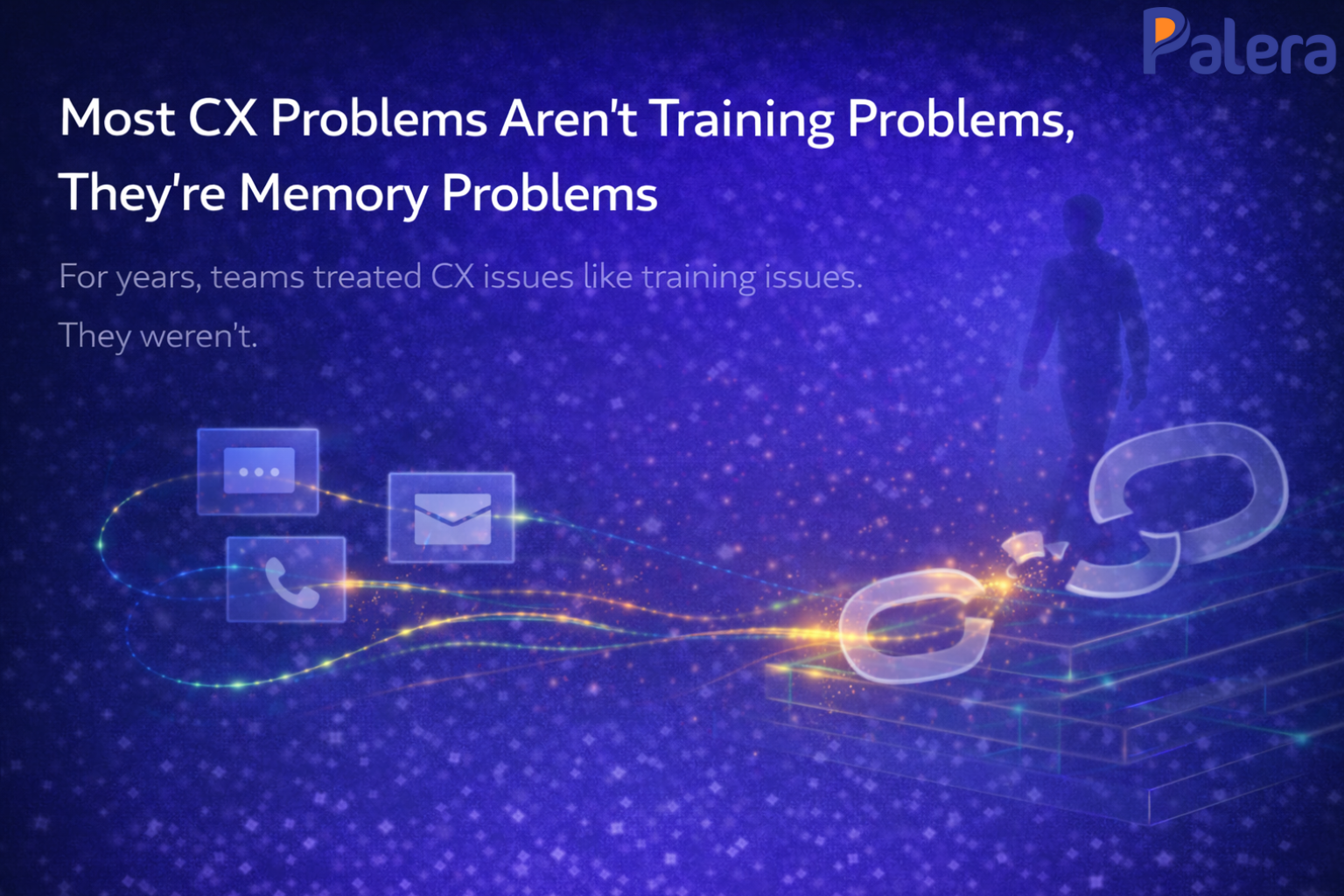




For years, teams treated CX issues like training issues.
Missed chats?
Retrain.
Slow responses?
Add QA.
Customers repeating themselves?
Rewrite scripts.
None of it worked.
Because the real issue wasn’t skill.
It was memory.
Training Can’t Fix What Systems Forget
Agents weren’t failing.
They were starting blind.
Every channel lived in its own silo.
Live chat had history.
Text had history.
Voice had history.
But none of them talked to each other.
So when a customer switched channels, the conversation restarted from scratch.
Same issue.
Same customer.
Zero context.
That reset adds time, kills productivity, and quietly erodes trust.
The Question Customers Keep Asking
Eventually, clients started asking for basic continuity:
“If a customer chats today and texts tomorrow, can you connect the two?”
Technically? Yes.
Operationally? No.
Because connecting those conversations required:
- exporting logs
- manually matching threads
- reconstructing timelines after the fact
That’s not CX.
That’s damage control.
And customers feel the disconnect immediately.
Why Coaching Isn’t the Answer
You can’t coach your way out of missing context.
No amount of training fixes a system that forgets what just happened.
Agents end up:
- asking questions customers already answered
- re-validating decisions already made
- improvising instead of resolving
Leadership ends up optimizing behavior instead of fixing structure.
The Real Root Cause
Most CS friction isn’t human error.
It’s architectural amnesia.
When systems don’t carry memory forward, experience can’t compound.
Until conversations persist across channels and time, CX will always feel slower, clumsier, and less human than it should.
This isn’t a training gap.
It’s an infrastructure gap.
And memory is the missing layer.